
September 3, 2026 · 5 min read · Training
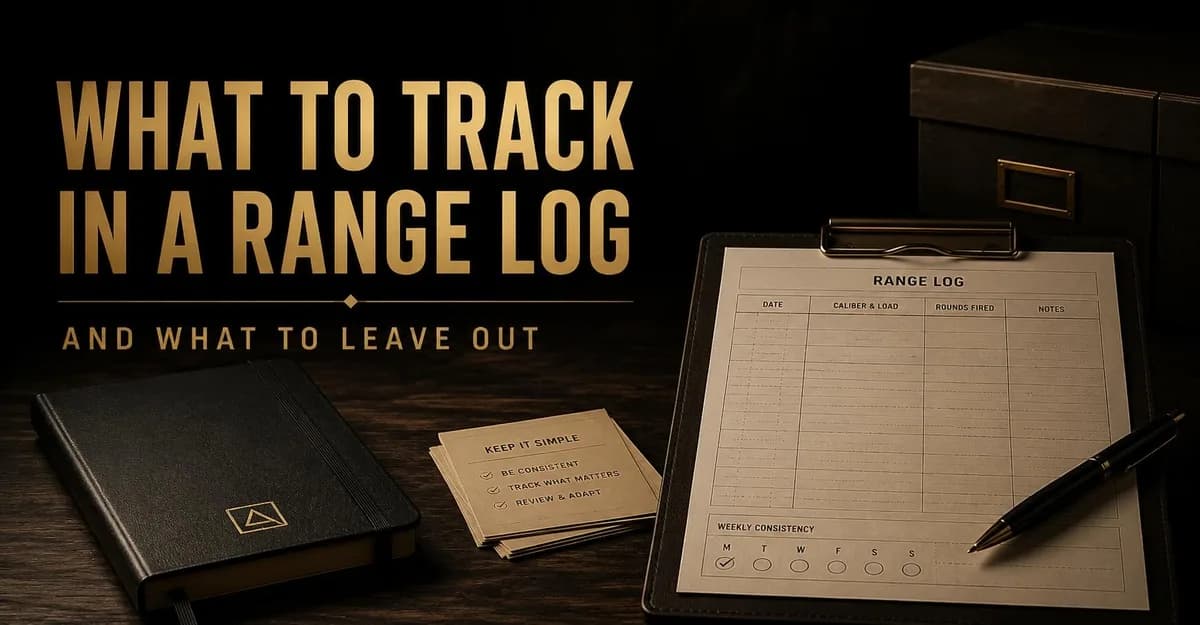
Most range logs do not fail from lack of discipline.
They fail because they ask for twelve fields. You fill them in carefully for two weeks, and then one evening the log takes longer than packing up does — and that is the last entry. AmmoKeep came out of exactly that experience; it is built by shooters, for shooters, with as few fields as we could get away with.
A log is only as good as its last entry
Twelve columns with three entries is worthless. Four columns with sixty entries is where the value is.
The reason is unglamorous: after a session you want to pack up and drive home, not fill in forms. Anything that takes more than about thirty seconds gets skipped eventually, and in practice "skipped once" means "never again".
So the question is not what could I record. It is:
What is the minimum I can still read something out of six months from now?
The four fields that survive
- Date
- Caliber and load — this is what connects the log to your inventory
- Rounds fired — the highest-leverage field, see below
- One line of notes — what worked, what did not
Add a fifth only if it applies to you: which firearm, when you own more than one in the same caliber. That single field is what makes round count tracking possible, and maintenance intervals are specified per gun.
From those fields you can already derive average rounds per session, training frequency across the year, the split across disciplines, and — combined with stock — how long your ammo lasts.
What to deliberately leave out
This is the part template articles skip. These fields show up in a lot of log sheets and cost more than they return:
- Weather and temperature. Genuinely matters for long range. For 25 yard pistol work it is noise.
- Every string scored individually. It looks thorough and it is the most reliable way to stop logging entirely.
- Point of impact for every shot. That is what the target is for, and what the match sheet is for when it counts.
- Sleep, pulse, perceived form. Real tools in competitive training programs with a coach reading them. Without that, it is data collection with no consequence attached.
Rule of thumb: if you have left a field blank three sessions in a row, delete the field. It is not part of your log.
Why rounds fired is the field that pays
Of the four, round count has the most downstream value — and mostly not for training reasons.
Take a common rhythm: 150 rounds every two weeks. That is about 300 rounds a month, 3,600 a year. At a fairly ordinary cost per round, ammunition becomes comfortably the largest single expense in the sport, ahead of membership and range fees combined.
Without a logged round count you do not know that annual volume. And without the volume you can neither work out what the year cost you nor see a shortage coming before it happens.
That is why the range log and the inventory belong together rather than in two separate places — the entry that logs a session is the same entry that draws down stock. If you want to start on paper, the free range log template uses exactly these fields; if you would rather have the forecast fall out automatically, that is what per-caliber tracking does.
Separate practice from matches
One distinction earns its keep almost always: log match ammo separately from practice ammo.
Two reasons:
- Match ammo usually costs more. Averaged in with practice volume, your cost per round comes out wrong — and wrong in the direction that makes budgeting harder than it needs to be.
- Match demand is predictable. Matches are on a calendar. Knowing your per-match round count means buying that ammo when it is cheap rather than the week before, at whatever the price happens to be.
Bottom line
A good range log is not a complete one. It is one you are still filling in six months from now.
Four fields, thirty seconds, every time. Date, caliber and load, rounds, one line. Add anything beyond that only if you genuinely analyse it, and delete it again the third time you leave it blank.
The value does not show up in any single entry. It shows up half a year later, the first time you see how much you actually shoot and what it actually costs.
AmmoKeep – built by shooters, for shooters.