
February 25, 2026 · 4 min read · Inventory ·
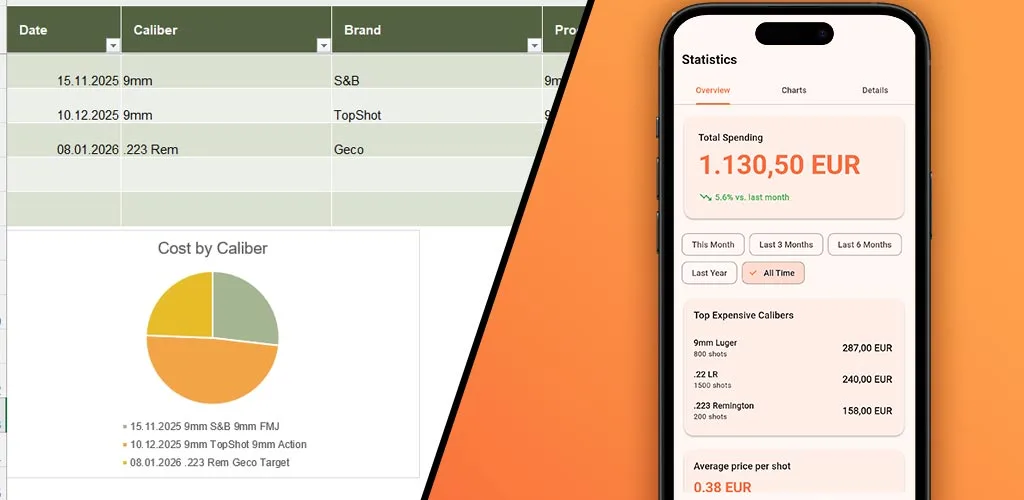
If you train regularly, you’ve probably experienced this:
A few boxes in the cabinet.
Some in your range bag.
And at some point, you’re no longer sure when you bought what — and what it actually cost you.
That’s exactly where I found myself.
In November 2025, I bought 550 rounds of 9mm S&B for €150 from a club member.
In December, I picked up 1,000 rounds of TopShot on sale for €239.
And suddenly I had a simple but important question:
Which deal was actually cheaper?
Even more importantly:
- How long will my current stock last?
- When do I need to reorder?
- How are my ammunition prices changing over time?
Those questions are exactly why AmmoKeep was created —
built by shooters, for shooters.
Why Excel Often Breaks Down for Ammo Tracking
Creating a spreadsheet is easy.
Keeping it accurate over time isn’t.
What usually happens:
- You log purchases immediately — but forget to log consumption.
- Different calibers get mixed together.
- Prices per batch are not tracked separately.
- You know your total stock — but not your purchase history.
If you shoot regularly — for example 100–200 rounds every two weeks — this adds up quickly.
At an average of 150 rounds per session, that means:
- ~300 rounds per month
- 3,600 rounds per year
Without structured tracking, it’s easy to lose visibility.
What Data You Actually Need
You don’t need a complicated database.
Four core data points are enough:
- Caliber and manufacturer
- Quantity purchased per batch
- Total price of that batch
- Rounds used per training session
With just these, you can automatically calculate:
- Cost per round
- Remaining stock
- Average monthly usage
- Estimated time until reorder
Let’s Compare the Deals
Deal 1
550 rounds for €150
→ 150 / 550 = €0.27 per round
Deal 2
1,000 rounds for €239
→ 239 / 1,000 = €0.239 per round
Even though the second purchase had a higher total price,
it was the better deal per round.
Without proper tracking, that difference is easy to overlook.
If you have two specific offers in front of you, the cost per round calculator puts them side by side — shipping included.
How Long Will Your Ammo Actually Last?
Let’s say you currently have:
- 1,550 total rounds in stock
- Average usage: 150 rounds every two weeks
That equals roughly:
- 300 rounds per month
1,550 / 300 ≈ 5 months of supply
That single calculation answers one of the most important questions:
When do I need to reorder to avoid running out?
Why Tracking Ammo Is Worth the Effort
Many shooters think:
“I roughly know how much I have.”
But the real value isn’t just knowing the total count.
It’s about:
- Understanding price trends
- Comparing manufacturers
- Planning reorders
- Controlling your shooting budget
If ammunition prices fluctuate 10–20% over a year,
you’ll barely notice without proper documentation.
When you track each batch, you can:
- Identify good deals
- See long-term price changes
- Make smarter purchasing decisions
Common Mistakes in Ammo Inventory Management
- Tracking only total stock instead of batches
- Mixing training and match ammunition
- Not calculating cost per round
- No defined minimum stock level
- Logging purchases but not consumption
Your inventory is only as accurate as your last update.
Final Thoughts
Whether you use a spreadsheet, a notebook, or an app —
what matters most is having a consistent system.
But once you’re managing multiple calibers, batches, and regular training sessions, a structured solution becomes far more practical.
AmmoKeep was built from exactly these real-world questions:
- What does my ammo actually cost me?
- How long will my stock last?
- When do I need to reorder?
If you want a simple, offline-first way to track your ammunition and expenses, take a look at AmmoKeep.
AmmoKeep – built by shooters, for shooters.