
September 3, 2026 · 6 min read · Cost
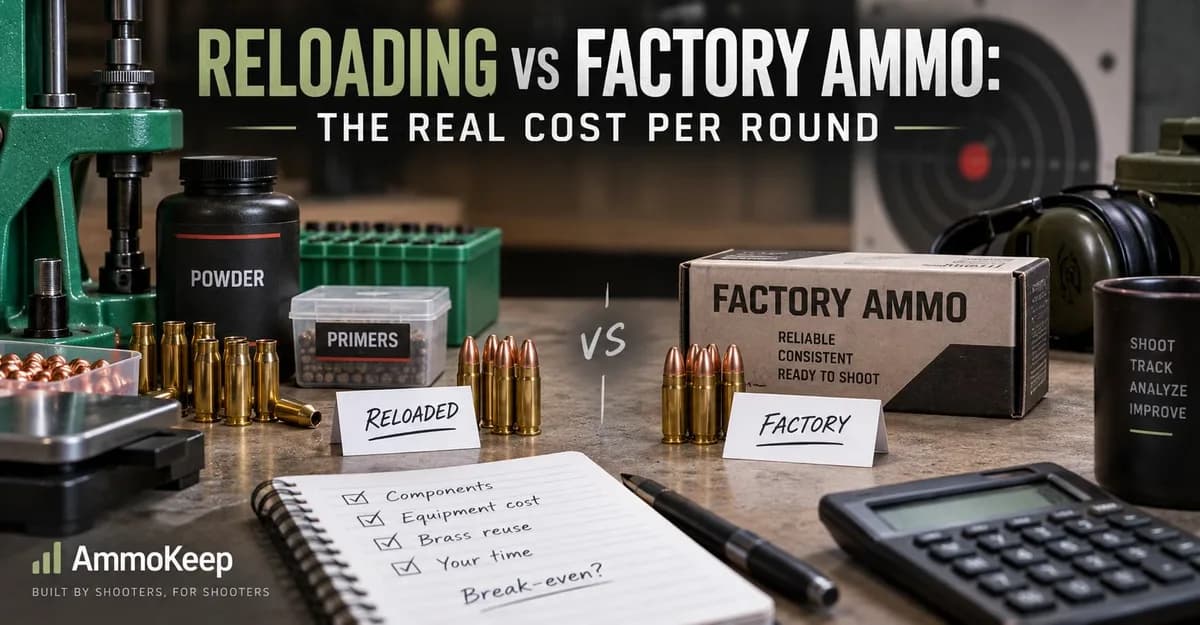
"Reloading is cheaper" is one of those claims that is true, false, or irrelevant depending entirely on how much you shoot.
The comparisons you usually find quote component costs and stop there — which is the one calculation guaranteed to make reloading look good. The honest version has three parts most articles skip. AmmoKeep is built by shooters, for shooters, and cost per round is the number the app exists to get right.
The three things most comparisons leave out
1. Equipment amortisation. A press, dies, a scale, a tumbler and the rest are a real cost. Spread over 500 rounds they dominate the calculation. Spread over 50,000 they round to nothing. Any per-round figure that ignores the setup is a figure for someone who already owns the setup.
2. Brass as a consumable. New brass is a substantial share of component cost. Reused brass is nearly free but has a finite number of firings, and how many depends on the cartridge, the load and the chamber. Treating brass as free is the most common way reloading costs get understated.
3. Your time. Not everyone counts it, and that is a legitimate choice — for a lot of reloaders it is part of the hobby rather than a cost. But it should be a stated choice, not an omission. At any hourly value above zero, low-volume reloading stops making financial sense quickly.
The structure of the calculation
Two numbers, then a division:
Component cost per round = (primer + powder charge + bullet + brass share) / 1
Reloading cost per round = component cost + (equipment cost / rounds over its life)
And the comparison you actually care about:
Break-even volume = equipment cost / (factory cost per round − component cost per round)
That last line is the whole article. The saving per round is only the component gap; the equipment cost is what you have to shoot through before that gap starts paying you back.
A worked structure
Rather than quote prices that will be wrong in your market next quarter, here is the shape of it with placeholder figures — substitute your own:
| Item | Per round |
|---|---|
| Factory ammunition | F |
| Primer + powder + bullet | C |
| Brass, amortised over its firings | B |
| Component total | C + B |
| Saving per round | F − (C + B) |
If your equipment package costs E, you break even at E / (F − (C + B)) rounds.
Two things fall out of this immediately:
The cheaper the factory ammo, the worse reloading looks. Common pistol calibers like 9mm are mass produced and cheap, so the gap F − (C + B) is small and the break-even volume is high. This is why "is reloading worth it for 9mm" gets argued about endlessly — the answer genuinely depends on volume in a way it does not for other cartridges.
The more expensive the factory ammo, the faster it pays. Match rifle and large or uncommon cartridges have a much wider gap. That is where reloading breaks even at volumes an ordinary shooter actually reaches.
The volume question is the whole question
Take the pistol rhythm from our own logs: 150 rounds every two weeks, about 3,600 rounds a year.
Whether that volume clears a break-even point depends entirely on the gap. A wide gap on an expensive cartridge might break even in a year. A narrow gap on bulk 9mm might take several — during which the equipment has to keep working and you have to keep wanting to do it.
There is also a real point that has nothing to do with money: reloading buys control and availability, not just cost. Load development for a specific rifle, and being able to produce ammunition when a caliber is hard to source, are worth something on their own. If those are your reasons, the break-even calculation matters less — but you should know what it says anyway.
What to actually track
The calculation is only as good as the inputs, and the inputs come from records:
- Component purchases as separate entries — primers, powder, bullets, brass, each with quantity and price
- What each batch of loaded ammunition cost — components consumed divided by rounds produced
- Brass firing count — how many times a given lot has been through
- Factory purchases for the same caliber — you cannot compare against a price you did not record
Point 4 is the one people skip, and it makes the comparison impossible. If you only track reloading costs, you are comparing your real numbers against a remembered factory price — and the remembered price is usually the highest one you ever paid. Our ammo price comparison is a faster way to get an honest F than a number from memory.
For a single comparison, the cost per round calculator handles the arithmetic including shipping. For the running average across batches over time, that is what per-caliber cost tracking is for. Either way the method is the same one in cost per round by caliber.
Bottom line
Reloading is cheaper per round and more expensive per year until you cross your break-even volume. Where that point sits depends on the price gap for your specific cartridge and the cost of your setup — not on a number from a forum.
Work out E / (F − (C + B)), compare it to what you honestly shoot in a year, and you will have an answer that is actually yours.
AmmoKeep – built by shooters, for shooters.