
September 3, 2026 · 5 min read · Training
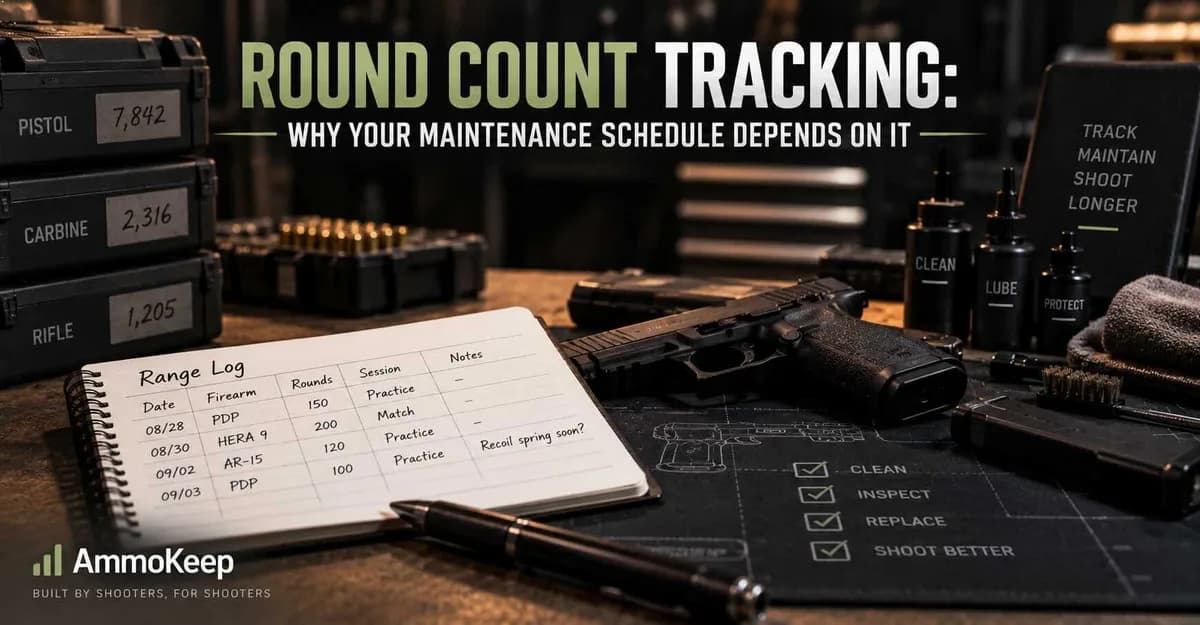
Ask a shooter how many rounds are through their carry gun and you usually get a range: "maybe eight, ten thousand?"
Ask what the recoil spring interval is for that model and you often get a precise number. That combination — a precise interval and a guessed count — is the whole problem. AmmoKeep exists because we kept running into it ourselves; it is built by shooters, for shooters.
What the number is actually for
Round count is not trivia. Three things depend on it, and all three are cheaper to handle early than late:
Maintenance intervals. Recoil springs, extractors, magazine springs and gas rings are specified in rounds, not months. A spring replaced at the right interval costs a few dollars; one that fails during a match costs the match.
Barrel life. Relevant mostly for rifles, and hugely dependent on cartridge and how hot you run it. A .22 LR barrel will outlast you. A high-intensity magnum barrel has a service life you can genuinely shoot through. If accuracy starts drifting, the round count is the first number worth looking at.
Diagnosis. When a firearm starts malfunctioning, "how many rounds since the last spring change" turns a guessing game into a short list.
The two mistakes that make counts useless
Counting per shooter instead of per firearm
Total rounds fired tells you about your training volume. It tells you nothing about any specific gun.
If you own three pistols in 9mm, one aggregate 9mm number cannot drive a maintenance schedule for any of them. The count has to live on the firearm, not on the caliber and not on you.
This is also why the firearm column exists in a range log at all — it is the field that makes the rest of the data actionable.
Starting from zero on a used gun
If you bought it used, the count does not start at zero and pretending otherwise builds a schedule on a false baseline.
The honest approach is to write down an estimate, mark it clearly as an estimate, and reset the maintenance clock yourself: replace the springs now, note the count at which you did it, and track intervals from that point forward. An unknown total with a known "rounds since last service" is far more useful than a confident-looking number you invented.
What to record
Round count tracking is a subset of a range log, not a separate system. Per session:
- Date
- Firearm — the field that makes this work
- Rounds fired
- Caliber and load — so it also feeds inventory
- Session type — practice, match, zeroing
Then one number per firearm that is not per session: rounds at last service, and what was serviced. Current count minus that figure is your interval, and it is the number you actually act on.
A worked example
A pistol with a 5,000 round recoil spring interval, shot at 150 rounds every two weeks:
- 300 rounds a month
- 3,600 rounds a year
- The spring is due roughly every 17 months
That interval is the reason guessing fails. Seventeen months is long enough that nobody remembers, and short enough that it comes around repeatedly. It is exactly the kind of thing that has to be written down or it will not happen.
Run the same math on a rifle with a 3,000 round barrel at 40 rounds a month and you get six years — which is a different kind of problem, because that is long enough to lose the records entirely.
Round count and inventory are the same data
Here is the part worth noticing: the entry that logs 150 rounds through a specific pistol is the same entry that removes 150 rounds from your 9mm stock.
Logging it twice, in two places, is how one of them quietly stops being maintained. Logged once, it drives the maintenance interval, the remaining stock, the consumption average and — combined with what the batch cost — the actual cost of that session.
That is the workflow AmmoKeep is built around; you can see how consumption logging feeds the per-caliber forecasts. If you would rather start on paper, the free range log template has the same fields.
Bottom line
Round count only works if it is attached to a firearm and captured as part of a habit you already have.
The interval math is simple, the payoff is a spring changed on schedule instead of during a match, and the whole thing costs one extra field in a log you should be keeping anyway.
AmmoKeep – built by shooters, for shooters.