
September 3, 2026 · 5 min read · Inventory
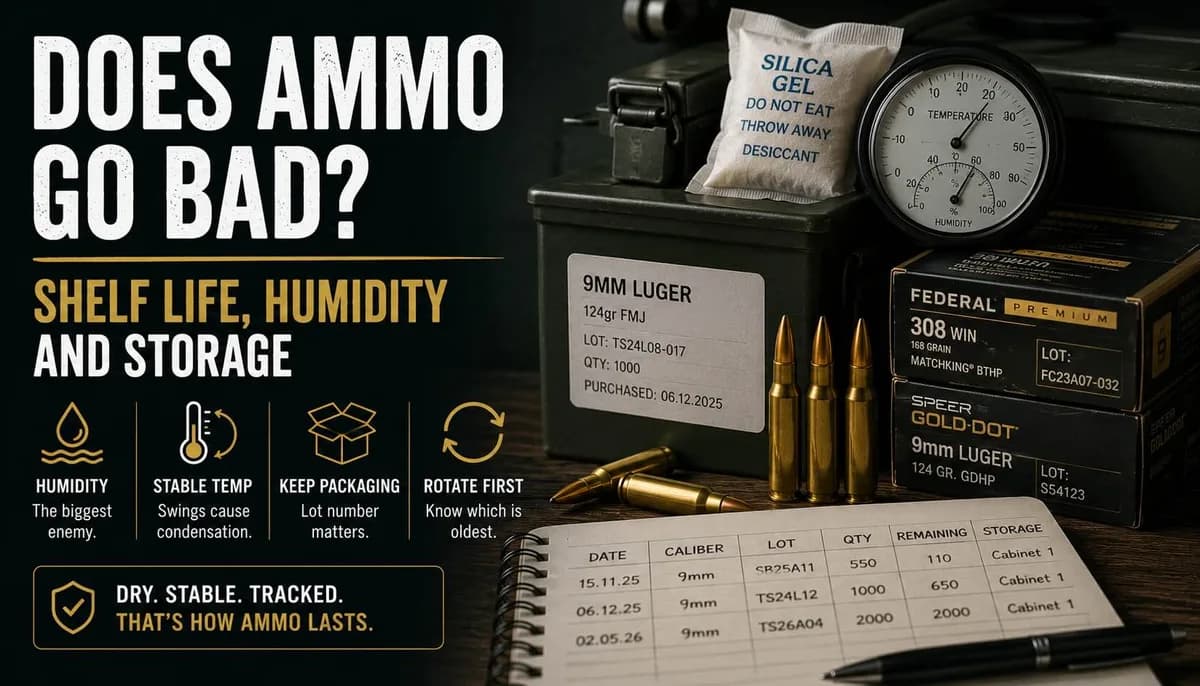
Short answer: not really, and much more slowly than most people assume.
Modern factory ammunition kept dry and at a stable temperature stays serviceable for a very long time. What ruins ammunition is almost never age by itself — it is storage conditions, and one of them matters far more than the rest. AmmoKeep is built by shooters, for shooters, and the practical half of this comes from keeping our own stock in order.
Age is not the variable
Ammunition has no meaningful expiry date the way food does. It has storage conditions, and the failure mode is chemical and mechanical rather than a clock running out.
That is why "how old is it" is the wrong first question. Where has it been is the right one. A box from a decade ago in a dry cabinet is in better shape than one from two years ago that spent a summer in a car boot.
What actually degrades ammunition
Humidity — by a wide margin the main one. Moisture attacks cases and can, over time, work past the seals into propellant and primers. Corrosion on the case is the visible symptom; it is also the warning sign that shows up before anything you cannot see.
Temperature swings, not temperature itself. This is the part that gets storage decisions wrong. A consistently cool space and a consistently warm space are both fine. A space that cycles between them is not, because each cycle drives condensation — and condensation is humidity delivered directly onto the cartridges.
This is why an unheated garage or shed is usually a worse choice than a heated interior room, even though the garage feels cooler and more "storage-like". The garage swings; the interior room does not.
Direct sunlight and heat sources. Sustained heat degrades propellant. Keep boxes out of the sun and away from radiators.
Solvents and oils. Oil creeping into a primer will kill it. Do not store cleaning supplies sealed in with loose ammunition, and do not oil cartridges.
Practical storage
- A dry interior room beats a cool damp basement. Stability first, temperature second.
- Desiccant works and is cheap. The only thing that matters is actually replacing or drying it out; a saturated pack does nothing.
- Keep the factory packaging. Repacking into loose containers gains very little and loses the lot number printed on the box — which you will want later.
- Airtight containers help in damp climates, but only if what you seal in is already dry. Sealing humid air in with the ammunition is worse than leaving the box on a shelf.
- Shoot the oldest first. Simple in principle, which brings us to the actual problem.
The part nobody mentions: knowing which is oldest
"Rotate oldest first" is standard advice and almost useless on its own, because it assumes you know which box is oldest.
Open most cabinets and you find several partially used boxes of the same caliber, bought at different times, with nothing on them to say when. At that point rotation is guesswork, and so is any judgement about how long a given batch has been sitting.
What makes it work is recording each purchase separately — date, manufacturer, lot, quantity, and where it is stored. That is a few seconds at the point of buying, and it is the only moment the information is available for free. Reconstructing it later from memory does not work.
The free ammo inventory template has those columns; per-batch tracking in the app does the same thing with the remaining count updating itself as you log sessions.
When to inspect rather than shoot
Ammunition that has been stored badly usually tells you before it fails. Worth a look before loading:
- Green or white corrosion on cases or primers
- Bullets that move under thumb pressure in the case mouth
- Cases that are visibly discoloured or pitted
- Anything that got wet, regardless of how it looks now
Old is not a reason to discard ammunition. Corroded, contaminated or waterlogged is. If a batch looks questionable and you cannot say where it has been, it is not worth finding out at the firing line.
What this means for stockpiling
Because well-stored ammunition keeps for years, shelf life is rarely the constraint on how much to hold. The real limits are secure storage capacity and the money tied up in it — a planning question rather than a chemistry one, covered in how much ammo should I stockpile.
Storage and purchase regulations differ by jurisdiction. This article covers storage conditions and shelf life only, not legal requirements — check what applies where you live.
AmmoKeep – built by shooters, for shooters.